Australia’s rich tapestry of myth and folklore is woven with stories that defy easy explanation, and perhaps no creature embodies this mystery quite like the Bunyip. Emerging from the murky waters of swamps, rivers, and billabongs, this enigmatic figure has captured imaginations for generations. The Bunyip is often described as a terrifying beast lurking in the shadows, a guardian of the unknown, and a harbinger of doom. As you delve deeper into the tale of the Bunyip, you discover a creature that is as elusive as the mists that shroud its watery home, inviting speculation and curiosity at every turn.
Origins of Bunyip
Historical Background
As you explore the historical roots of the Bunyip, you find that its origins are deeply entwined with the Aboriginal cultures of Australia. The term “Bunyip” comes from the Wemba-Wemba or Wergaia language of Aboriginal Australians, translating roughly to “devil” or “evil spirit.” Through oral traditions passed down over centuries, Aboriginal peoples have recounted tales of the Bunyip inhabiting creeks, swamps, and riverbeds, suggesting a creature that is both feared and respected.
Historical accounts reveal that when European settlers arrived in Australia in the early 19th century, they encountered these stories and were both fascinated and frightened by them. Early settlers recorded tales of encountering the creature, describing strange noises emanating from the water at night and finding half-eaten livestock on riverbanks. These accounts, combined with Aboriginal stories, painted a picture of a formidable creature lurking just out of sight.
Moreover, European descriptions varied significantly, often influenced by the animals that were unfamiliar to them. Crocodiles and seals were initially thought to be the cause of the mysterious happenings attributed to the Bunyip. Over time, explorers, naturalists, and anthropologists documented these stories, contributing to the growing mythos of the Bunyip and its place in Australian folklore.
Mythological Significance
The mythological significance of the Bunyip extends beyond mere folklore; it serves as a symbol of the untamed and mysterious parts of the Australian landscape. To the Aboriginal peoples, the Bunyip embodies the dangers and spirits of the water, acting as a guardian of sacred spaces. These bodies of water were often considered places of great spiritual power, where the boundary between the physical and spiritual world blurred.
In many Aboriginal cultures, the Bunyip is not just a creature of fear but also one of reverence. It is believed to possess a spiritual essence that commands respect. This duality illustrates the Bunyip’s role as an enforcer of natural laws, warning against the over-exploitation of natural resources. The creature’s tales serve as cautionary narratives, advising against disturbing the delicate balance of the natural world.
Furthermore, the Bunyip’s mythological role emphasizes the interconnectedness of human, natural, and spiritual realms. By embodying the mysterious and often unpredictable nature of water bodies, the Bunyip becomes a reminder of the inherent unpredictability and power of the natural world. This reinforces the need for both respect and caution, fostering a cultural understanding that resonates with environmental stewardship.
Description of Bunyip
Physical Characteristics
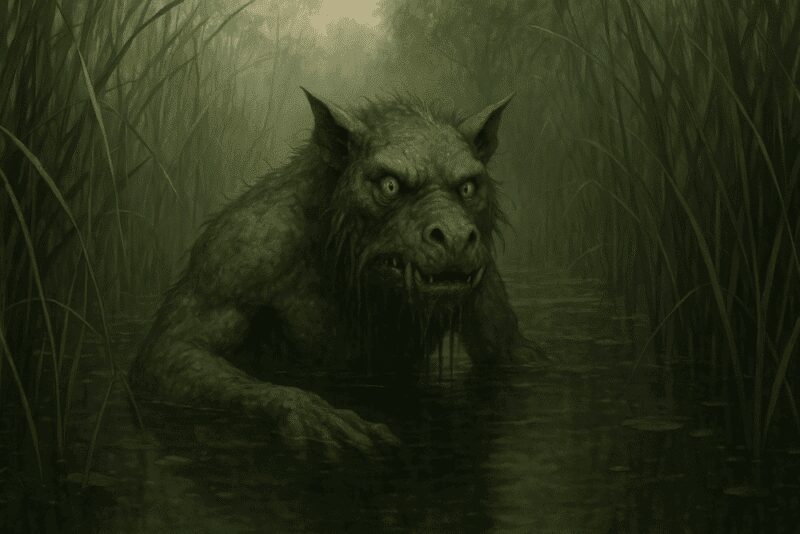
One of the most intriguing aspects of the Bunyip is its elusive and varied description across different accounts. As you delve into these descriptions, you’ll find that there is no singular image that captures the Bunyip’s appearance. Instead, it is depicted in myriad forms, from water-bound nightmare to an almost mythical chimera. Some stories describe it as a large, amphibious creature, with traits resembling a hippopotamus or a seal, while others liken it to more fantastical beasts with long necks, serpentine bodies, or horse-like heads.
The Bunyip’s physical characteristics often defy logic, with some accounts detailing it as having a face resembling a dog, dark fur, and yellow eyes that glow menacingly in the night. In other renditions, it bears tusks or horns, adding a predatory aspect to its already fearsome reputation. This diversity in description suggests not only the power of oral tradition but also the malleability of myth, shaped by regional variations and personal interpretations.
Despite these varied portrayals, a consistent theme is its association with water, sometimes described with webbed feet and a tail that aids in swimming. Whether you envision the Bunyip as a grotesque water monster or a cryptic guardian of the waterways, its ever-changing image adds to its mystique and enduring allure in Australian mythology.
Behavioral Traits
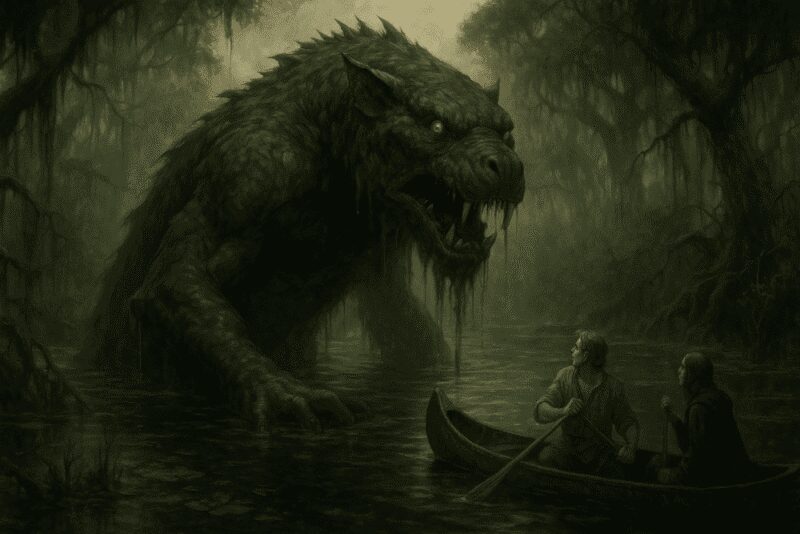
The Bunyip’s behavioral traits are as enigmatic as its physical appearance, contributing to its fearsome reputation. You learn that the creature is often depicted as nocturnal, emerging at night to hunt for its prey. This association with the night heightens its mysterious aura, as shadows and darkness cloak its movements, leaving evidence of its presence only in the chilling sounds and devastated remains it leaves behind.
According to many tales, the Bunyip is a solitary creature, fiercely territorial and rarely seen by those who respect its ground. It is said to be capable of producing terrifying roars or bellows, which can be heard echoing across the water. These vocalizations are often regarded as warnings to intruders or preludes to the Bunyip’s wrath. The chilling cries are believed to be capable of instilling fear and confusion in those who hear them, serving to scare away potential threats.
Despite its fearsome nature, the Bunyip is sometimes portrayed as a protector of its domain. In this role, it acts to maintain the natural balance, punishing those who exploit or harm its watery habitat. This aspect of the Bunyip underscores its dual role as both a predator and guardian, highlighting the complex relationships between humans and the natural world, and reinforcing the moral lessons embedded within its mythology.
Bunyip in Culture and Tradition
Role in Folklore
The Bunyip holds a significant place in Australian folklore, where it serves not only as a source of fear but also as a moral compass. As you explore its role in cultural narratives, you uncover stories that illustrate the consequences of breaching natural laws or intruding upon sacred territories. The tales often serve as cautionary fables, warning against reckless behavior and encouraging respect for the natural world and its spirits.
Folklore surrounding the Bunyip has been used by Aboriginal communities to impart important life lessons to younger generations. Through stories of encounters with this mythical beast, children and adults alike are taught about the dangers of wandering too far into unknown or forbidden territories, particularly those with spiritual significance. The Bunyip thus becomes a means of preserving cultural practices and beliefs, ensuring that the wisdom of ancestors is passed down through time.
In addition to its role as a moral teacher, the Bunyip has become a symbol of the unknown. In an ever-changing world, where the natural and cultural landscapes continuously evolve, the Bunyip represents the mysteries yet to be discovered and the need to approach the unfamiliar with respect and caution. This dual role of fearsome creature and cultural guardian cements the Bunyip’s place as a powerful emblem within Australian folklore.
Regional Variations
Another fascinating aspect of the Bunyip is its regional variations, which reflect the diverse landscapes and cultures of Australia. As you delve into these variations, you find that no two stories are quite the same. In some regions, the Bunyip is believed to dwell in deep swamps and billabongs, while in others, it inhabits fast-flowing rivers or the secluded backwaters of remote areas.
In the eastern parts of Australia, stories often depict the Bunyip as a water spirit with a more benign presence, perhaps reflecting the gentle nature of the waterways there. Meanwhile, in the arid regions of the interior, the Bunyip takes on a more fearsome guise, mirroring the harsh and unforgiving landscape. These differences highlight how the environment shapes the mythology and how the Bunyip serves as a mirror to the fears and hopes of the communities that tell its stories.
Regional variations also extend to the Bunyip’s appearance and behavior. In some tales, it is described as a colossal beast capable of immense destruction, while in others, it is more elusive, seen only fleetingly or through strange phenomena. These differences add rich layers to the mythology, creating a tapestry of stories that reflect the diversity of Australia’s peoples and its vast, varied geography.
Legends and Tales
Famous Encounters
Over the years, numerous stories and encounters with the Bunyip have captured the imagination of Australians and others intrigued by the creature. One such story comes from the early 1800s, where a group of settlers claimed to have seen a Bunyip at Lake Bathurst in New South Wales. The settlers described the creature as having dark fur and making a terrifying bellowing sound that echoed across the water, scaring their horses and sending chills down their spines.
Another famous tale tells of a Bunyip residing in the swamps near the Murrumbidgee River. Locals claimed that the creature was responsible for the mysterious disappearances of livestock and the eerie cries that occasionally pierced the night. These stories, told around campfires and in local pubs, served to perpetuate the myth of the Bunyip, instilling both fear and fascination in those who heard them.
Perhaps the most compelling encounter occurred in the 1840s when strange bones were discovered near Geelong, Victoria. Local scientists speculated that the remains could belong to the Bunyip, and for a time, the creature was at the forefront of public intrigue. Although modern science later identified these bones as those of a prehistoric marsupial, the excitement surrounding the discovery highlighted the pervasive nature of Bunyip legends and their ability to capture the public imagination.
Symbolism and Meaning
The Bunyip is rich in symbolism and layered meanings, reflecting both cultural and environmental themes. On one level, the creature symbolizes the fear of the unknown, a common element in myths worldwide. As you uncover the Bunyip’s many interpretations, you see how it embodies the anxieties and mysteries associated with unexplored territories and the depths of the natural world.
Moreover, the Bunyip can be seen as a metaphor for the balance between humans and nature. Its stories often center on themes of respect and retribution, warning of the consequences of disrupting natural harmony. This interpretation casts the Bunyip as a guardian of the environment, reminding humans of their role within the ecosystem and the importance of sustainable practices.
Additionally, the Bunyip represents the rich tapestry of Aboriginal culture and the deep spiritual connections with the land and its creatures. By embodying both the physical and spiritual aspects of water sources, the Bunyip serves as a bridge between worlds, illustrating the interconnectedness of all life and the respect due to the forces that inhabit these sacred spaces.
Bunyip in Modern Times
Literature and Media
The legend of the Bunyip has transcended traditional storytelling, finding a place in modern literature and media. As you explore these contemporary representations, you’ll discover that the Bunyip continues to captivate audiences, whether through books, films, or games. In literature, the Bunyip has appeared in works such as “The Bunyip of Berkeley’s Creek” by Jenny Wagner, a children’s book that reimagines the creature in a friendly and introspective light, reflecting the diverse interpretations the Bunyip has inspired.
In Australian cinema, the Bunyip has surfaced as a subject of intrigue and terror, often depicted as a lurking menace in horror and thriller genres. Films like “The Bunyip” have attempted to explore its mysterious nature, drawing on the creature’s rich folklore to build suspense and fear. This visual representation allows the Bunyip to reach new audiences, highlighting its role as a cultural icon with enduring appeal.
Video games have also embraced the Bunyip, weaving it into interactive experiences that allow players to confront the mythical beast themselves. Titles like “Australian Adventure” incorporate the Bunyip as a formidable opponent or an ally, depending on the narrative, reflecting both the creature’s fearsome reputation and its potential for deeper symbolism and meaning.
Contemporary Relevance
In today’s world, the Bunyip remains a relevant and powerful symbol, resonating with modern audiences on multiple levels. Its persistence in cultural conversations highlights an ongoing fascination with myth and folklore, reflecting a broader interest in understanding the narratives that shape human experience. By examining the Bunyip, you gain insights into the ways in which ancient stories continue to inform contemporary identities and values.
Environmental concerns have also brought renewed attention to the Bunyip, casting it as a symbol of nature’s fragility and the need for conservation. As discussions about climate change and the preservation of natural habitats intensify, the Bunyip’s role as a guardian of the waterways takes on new significance. It encourages a deeper reflection on humanity’s relationship with nature and the responsibilities that come with stewardship of the environment.
Additionally, the Bunyip serves as a cultural touchstone, representing the rich heritage and storytelling traditions of Indigenous Australians. As efforts to preserve and promote Indigenous cultures gain momentum, the Bunyip stands as a testament to the resilience and depth of these narratives. By engaging with the Bunyip, contemporary audiences can foster a greater appreciation for the cultural contributions of Australia’s First Peoples and the enduring power of myth.
Conclusion
The Bunyip remains an enduring figure in Australian mythology, embodying the mysteries of the natural world and the complex interplay between humans and the environment. As a creature of both fear and reverence, the Bunyip continues to captivate imaginations across generations. Its presence in folklore, literature, and media showcases the timeless allure of myth, underscoring the rich cultural tapestry of Australia and the universal themes that resonate through its stories.