In the shadowy realms of Japanese folklore, where the line between the earthly and the supernatural blurs, lurks a creature of both beguilement and terror — the Jorōgumo. This beguiling spider demon has captured the imaginations of many, weaving tales that balance beauty with menace. Her story is one of transformation, seduction, and a caution against the allure of the unknown. To delve into the myth of the Jorōgumo is to embark on a journey through ancient tales, where webs are spun not just of silk, but also of intrigue and danger.
Origins of Jorōgumo
Historical Background
The Jorōgumo originates from the depths of Japan’s rich mythological tapestry, a creature whose roots trace back to the Edo period, which spanned from the early 17th to the mid-19th century. This period saw the flourishing of literature and visual arts, creating fertile grounds for stories of yokai—supernatural entities that blend the mundane with the mystical. The Jorōgumo, specifically, is steeped in the tradition of tsukumogami, spirits that inhabit objects or beings when they reach a certain age, often a century.
In the world of arachnids, the Jorōgumo refers to the orb-weaving spider, Nephila clavata, known for its striking appearance and intricate webs. Over time, these physical attributes became entwined with folklore, giving rise to the myth of the Jorōgumo as not just a spider but a fantastical creature capable of transformation. This evolution from natural to supernatural was a common theme in Japanese folklore, where the natural world was often seen as imbued with spiritual significance.
As societal structures evolved during the Edo period, the tales of Jorōgumo also began to reflect deeper social anxieties. Her stories often explored themes of deception and hidden dangers lurking beneath attractive appearances, mirroring societal concerns of the time. The Jorōgumo’s transformation from a simple spider into a mythical demon exemplifies the era’s fascination with the balance between beauty and peril.
Mythological Significance
The Jorōgumo holds a significant place in Japanese mythology as a symbol of alluring danger. In the spiritual hierarchy of yokai, she stands as a testament to the nature of deception. Her ability to transform into a beautiful woman speaks to the fears and fascinations human beings harbor regarding appearances and hidden truths. As a creature that can straddle both the human and animal realms, the Jorōgumo embodies the unsettling potential for change and the unknown, appealing to the human imagination while also cautioning against blind trust.
Mythologically, the Jorōgumo serves as a bridge between the natural world and the supernatural. The stories that feature her often highlight her dual nature, emphasizing the precarious balance between human-like qualities and her innate predatory instincts as a spider. Such tales often impart moral lessons about greed, temptation, and the consequences of succumbing to superficial allure, reinforcing cultural values through vivid narrative.
Moreover, the Jorōgumo’s role as a mythological figure is intricately tied to Japan’s unique perspective on nature and spirits. In a land where Shinto beliefs underline the presence of spirit forms in all aspects of life, the Jorōgumo embodies the embodiment of nature’s beauty and unpredictability. Her stories remind us of the respect necessary for both the seen and unseen within the natural world, encapsulating a complex interplay of fear and reverence.
Description of Jorōgumo
Physical Characteristics
The Jorōgumo is described as a creature of stark duality, with her physical form reflecting the two worlds she inhabits. In her natural state, she is the jorō spider, an orb-weaving spider renowned for its distinctive web patterns and vivid coloration. These spiders are particularly noted for their golden silk, which catches sunlight with an ethereal glow. Within the folklore, this aspect is often exaggerated to portray webs that are not just beautiful but also captivating traps for the unwary.
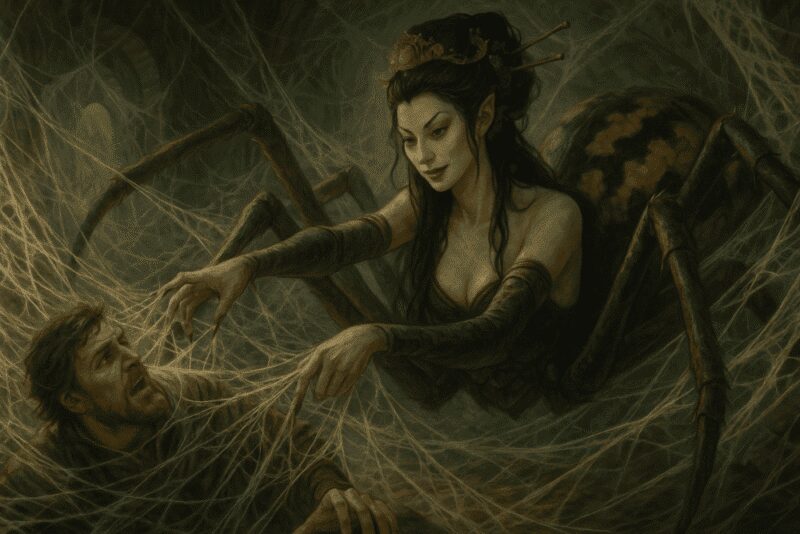
When the Jorōgumo transforms into her human guise, she is depicted as a strikingly beautiful woman, often adorned in traditional kimono. This transformation is a common element in yokai mythology, highlighting her ability to beguile humans with her appearances. Her human form is consistently flawless, with a beauty that is both ethereal and unsettling. This guise allows her to lure unsuspecting victims, underscoring the peril of judging purely by appearances.
Despite her human form’s allure, subtle details are often included in stories to hint at her true nature. Some tales speak of fleeting glimpses of her spider-like features, such as multiple eyes or sharp teeth, that are visible only to those who are exceptionally observant or in moments of her distraction. These subtle hints serve to remind audiences of her inherent danger and otherworldly origins, reinforcing the tension between her enticing facade and her monstrous reality.
Behavioral Traits
In folklore, the Jorōgumo exhibits a range of behaviors that are both captivating and chilling. Her modus operandi often involves isolating her prey; she is known to summon unsuspecting men to her lair under the guise of hospitality, only to ensnare them in her deadly web. This behavior reflects her dual nature as both a seductress and a predator, emphasizing the peril of succumbing to seduction without caution.
The Jorōgumo is also depicted as highly intelligent and cunning, qualities that elevate her above mere monstrousness to a figure of fearsome allure. She employs her wit and charm to craft intricate schemes, playing on the desires and weaknesses of her targets. Her intelligence is often highlighted in narratives where she deceives even the wisest of individuals, indicating her prowess as a master manipulator.
Despite her malevolent tendencies, some tales portray her with an ambiguous moral compass, adding complexity to her character. Occasionally, she may spare individuals who manage to outwit her or show particular bravery or virtue. These nuanced portrayals suggest that while the Jorōgumo is a fearsome entity, like many yokai, she operates according to her own set of rules and principles, aligning her more closely with ancient understandings of nature itself—a force that is both nurturing and destructive.

Jorōgumo in Culture and Tradition
Role in Folklore
The role of the Jorōgumo in Japanese folklore is both significant and multifaceted. As a prominent yokai, she embodies themes of deception, transformation, and the peril of superficial beauty, serving as a cautionary embodiment of these concepts. Her stories are deeply interwoven with traditional tales where she often appears as a seductress who lures men with her beauty and entangles them in her web of deceit, offering both entertainment and moral instruction.
Folktales featuring Jorōgumo often serve as allegories for societal issues, such as the consequences of superficiality and the dangers of succumbing to temptation. They reflect the cultural values of caution and the necessity of looking beyond appearances to discern the true nature of things. These stories were not merely for fright but were intended to reinforce ethical standards and societal norms through engaging narratives.
Furthermore, the Jorōgumo’s presence in folklore highlights the Japanese cultural fascination with the supernatural and the transformative. Her ability to change forms underscores a broader cultural narrative—a recognition of the fluidity between the ordinary and the extraordinary. This reflects a worldview that accepts the presence of otherworldly influences in everyday life, suggesting that the divine and the demonic can reside side-by-side with the mundane.
Regional Variations
Throughout Japan, the portrayal and perception of the Jorōgumo vary, shaped by regional folkloric traditions and the local landscape. In some areas, she is known by different names, such as the Binding Bride or the Binding Woman, reflecting localized interpretations of her myth. Each region adds its unique twists to her stories, reflecting the diversity of cultural expression across Japan.
For instance, in certain regions, the Jorōgumo is associated more closely with water, residing near waterfalls or deep pools, which serve as metaphors for her alluring yet dangerous nature. Water, a symbol of purity and peril, effectively enhances the mystique surrounding her character, adding layers to her seductive and threatening presence. This aquatic association also ties her to local legends and natural landmarks, embedding her myth within the physical geography of the land.
Other regions emphasize the Jorōgumo’s connection to the forest, further entwining her myth with the natural world. The forest, with its dense foliage and hidden secrets, serves as a perfect backdrop for her tales of transformation and concealment. These variations reflect the adaptability of her myth, allowing it to resonate with diverse audiences by aligning with their local environments and cultural contexts.
Legends and Tales
Famous Encounters
The legends of Jorōgumo are marked by several famous encounters that have cemented her place in the pantheon of Japanese folklore. One of the most notable tales involves a warrior named Hirase, who ventures into a forest where the Jorōgumo is rumored to reside. Drawn by her beauty, Hirase is ensnared in her web but manages to escape by outwitting her with a game of wits. His survival is often credited to his virtue and intelligence, serving as a moral exemplar within the story.
Another well-known narrative is the tale of the Jorōgumo of Jōren Falls. In this story, the Jorōgumo inhabits the waters surrounding the falls, luring fishermen to their doom. According to the legend, she would send a thread of silk up to pull them into the depths. The story reaches a climax when a Buddhist priest intervenes, using prayer and spiritual power to banish her, highlighting the triumph of faith and righteousness over malevolent forces.
These stories, rich with suspense and moral lessons, often portray heroes who must confront the Jorōgumo’s seductive powers with intellect and bravery. Through these encounters, the legends emphasize themes of vigilance and the necessity of seeing beyond appearances to overcome the challenges posed by the supernatural.
Symbolism and Meaning
The symbolism of the Jorōgumo extends deeply into the realm of human psychology and societal norms, representing the perpetual human struggle against deception and the unknown. Her dual nature as a beautiful woman and a fearsome spider is a potent metaphor for the dangers of hidden intentions and the risks of being seduced by appearances.
In a broader cultural context, the Jorōgumo symbolizes the tensions inherent in human-nature relationships. She embodies nature’s duality—its capacity for beauty as well as destruction. Her seductive allure can be seen as a representation of nature’s captivating power, which, if not respected and understood, can lead to ruin. This reflects a cultural moral lesson that advocates for respect and caution when dealing with nature and its myriad manifestations.
Moreover, the Jorōgumo is a reflection of gender dynamics and societal roles within the folklore genre. Her depiction as a woman who uses beauty and intelligence to entrap victims can be interpreted as an exploration of female agency and empowerment within a patriarchal context. At the same time, stories that end with her defeat reinforce traditional gender roles, suggesting a complex interplay between empowerment and subjugation in cultural narratives.
Jorōgumo in Modern Times
Literature and Media
The captivating myth of the Jorōgumo continues to influence modern literature and media, maintaining her relevance as a symbol of both fascination and fear. In literature, she appears in numerous works that explore themes of transformation and deception. Books such as “Kwaidan: Stories and Studies of Strange Things” by Lafcadio Hearn include tales that evoke the eerie allure of the Jorōgumo, introducing her to Western audiences and cementing her place in global folklore.
In film and television, the Jorōgumo often appears in horror and fantasy genres, where her dual nature and seductive powers are vividly portrayed. Movies like “Kwaidan” directed by Masaki Kobayashi, though not focusing solely on Jorōgumo, include elements of supernatural beauty and peril that echo her myth. She also features in anime series such as “Mononoke” and “GeGeGe no Kitarō”, where her character is reimagined in ways that highlight enduring cultural narratives surrounding yokai.
The world of video games has also embraced the allure of the Jorōgumo. Games such as “Nioh” and “Sekiro: Shadows Die Twice” feature her as an antagonistic force, allowing players to engage directly with her myth. These interpretations often emphasize the challenge of overcoming her illusions, providing a dynamic way for modern audiences to interact with the age-old tale of the Jorōgumo.
Contemporary Relevance
In contemporary society, the Jorōgumo remains a potent symbol of the complexities of beauty and danger, resonating with modern concerns about appearances and authenticity. Her myth serves as a reminder of the perennial caution against deception in an age where digital personas and curated images dominate social media. The stories of the Jorōgumo encourage critical engagement with the images and narratives we encounter daily, urging a deeper investigation beyond the surface.
Furthermore, the Jorōgumo’s representation of duality speaks to contemporary discourses on identity and transformation. As society increasingly recognizes the fluidity of identity, the Jorōgumo’s ability to shift forms mirrors these discussions, offering a mythic lens through which to explore personal and societal change. She becomes a metaphor for the multifaceted nature of identity in a rapidly evolving world.
In the realm of gender politics, the Jorōgumo’s story invites reflection on the roles of power and agency. Her characterization as a woman who wields beauty and cunning presents an opportunity to explore themes of empowerment, autonomy, and the subversion of traditional gender roles. As societies continue to grapple with these themes, the Jorōgumo’s myth provides a rich narrative framework for understanding and challenging the status quo.
Conclusion
The Jorōgumo, with her alluring yet menacing presence, remains an enduring figure in Japanese mythology and beyond. Her stories captivate with their blend of beauty and danger, weaving lessons that transcend time and culture. As both a cautionary tale and a symbol of enchantment, the Jorōgumo continues to intrigue, reminding us of the complex interplay between appearance and reality that pervades human existence.